Received a notice from Cigna or Baptist Health? All CareSpot Urgent Care locations, including those affiliated with Baptist Health, will continue to accept patients with Cigna insurance plans.

Translate
High Contrast
Translate
High Contrast
As temperatures drop across the country, the fall wave of illness is beginning. Even though there is now a COVID-19 vaccine, that virus remains a threat, along with cold and flu.
COVID-19 and the flu are two different conditions with different causes. COVID-19 is caused by the coronavirus while flu is caused by the influenza virus.
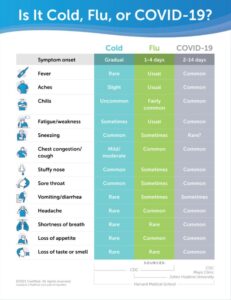
With more than a year of research about COVID-19, we know that many of its symptoms overlap with cold and flu. That can make it difficult to know whether you might need to be tested for COVID-19 or flu. The infographic below can be a helpful first step:
Unlike COVID, the influenza virus has existed for centuries. Flu is a respiratory illness that typically infects the nose, throat and/or lungs, with symptoms ranging from mild to severe. For some, these symptoms can be deadly. Flu season usually begins in October and ends in May, peaking between December and February.
Many COVID-19 infections can appear to be similar to flu. Fever, headaches, fatigue and chills are fairly common with both viruses, according to research from Harvard Medical School and Johns Hopkins University.
A few symptoms separate COVID-19 from flu. Shortness of breath and the loss of taste or smell have been widely reported by COVID-19 patients but are rare in people who have the flu.
Flu patients might also begin showing symptoms more quickly than COVID-19 patients. Flu symptoms can show up just a few days after exposure while COVID-19 symptoms might take up to two weeks.
COVID-19 seems to spread more easily than flu and causes more serious illnesses in some people. COVID-19 does not spread as commonly through contact with contaminated surfaces. But it generally spreads between people who are in close contact with each other (within six feet). And people can spread the virus to others even they personally do not show any symptoms.
Some symptoms that both the flu and COVID-19 viruses share include: fever, chills, cough, sore throat, runny or stuffy nose, shortness of breath or difficulty breathing, fatigue, headache, and muscle pain or body aches.
There are vaccines for both flu and COVID-19 prevention.
One of the best ways to prevent the flu during flu and cold season is by getting the flu vaccine each year. This includes adults as well as kids, who can have the flu vaccine as young as six months old. It’s safe for children 6 months and older because the flu vaccine has been extensively tested, is recommended by the CDC and the American Academy of Pediatrics, and helps protect young children—who are at higher risk of flu-related complications—from getting seriously ill.
The silver lining here: getting vaccinated for both the flu and COVID can help reduce the spread of these viruses. As new variants of COVID emerge, it’s more crucial than ever to get your flu vaccine. If more people are vaccinated for the flu, then fewer people will get sick or require flu-related hospitalization, leaving more resources available for COVID patients. Recent research also confirms the safety of the flu vaccine in relation to COVID – in fact, getting a flu vaccine might even lower your risk of becoming infected with the COVID virus. The flu vaccine and COVID vaccine can work safely together to help keep you and your loved ones healthy.
If you’re feeling under the weather, it is possible that you don’t have the flu or COVID-19; it might just be an ordinary cold.
People with colds rarely have the fever, digestive problems, headaches or loss of appetite seen in flu or COVID-19 patients. It is also rare for cold sufferers to have shortness of breath or a loss of taste or smell.
Colds do usually bring sneezing, which is less common in flu cases and somewhat rare in COVID-19 infections. Colds also progress gradually, in contrast to the sudden onset of flu symptoms.
Because so many of the flu symptoms vs. COVID and cold symptoms vs. COVID are similar, it can be difficult to diagnose someone based on their symptoms alone.
PCR (Polymerase Chain Reaction): Highly accurate, usually done with a nasal or throat swab; results may take longer (hours to a day).
Rapid Antigen Tests: Provide results in about 15–30 minutes; useful for quick screening but may be less sensitive than PCR.
Flu Swabs: Nasal or throat swabs that check for influenza A and B; can be rapid or lab-based.
Combined Panels: Some tests check for COVID-19, flu, and RSV at the same time.
If you have overlapping symptoms (fever, cough, body aches, sore throat, fatigue).
After known exposure to someone with COVID-19 or the flu.
If you are at higher risk of complications (older adults, people with chronic conditions, or weakened immune systems).
Before visiting high-risk settings (e.g., nursing homes, hospitals, or around vulnerable loved ones).
Helps your healthcare provider determine the right treatment (such as antivirals for flu or COVID-19).
Reduces the risk of spreading illness to others.
Provides clarity and peace of mind when symptoms are similar.
If you’re feeling sick, an urgent care center near you are here to help with flu tests, COVID-19 evaluations, and many other urgent care services.
Wait! Do you take my insurance? Who will see me? What will I owe?
Not to worry — check out all of that here.